What is astrocartography? A clear guide to the map and its lines
Learn how a natal chart becomes a world map, what angular planetary lines represent, why exact birth time matters and how to use the result responsibly.
By Oleh Khmelnytskyi, founder and editor, AstraRead · Updated
The short answer
Astrocartography is a branch of locational astrology that plots on a world map where each natal planet was on the Ascendant, Descendant, Midheaven or IC at the moment of birth. It compares symbolic location themes; it cannot prove the best city or guarantee events.
Key points
- The map begins with a calculated natal chart.
- Each planet can form Ascendant, Descendant, Midheaven and IC lines.
- A map should be combined with practical research, not used as a relocation verdict.
How a birth chart becomes a world map
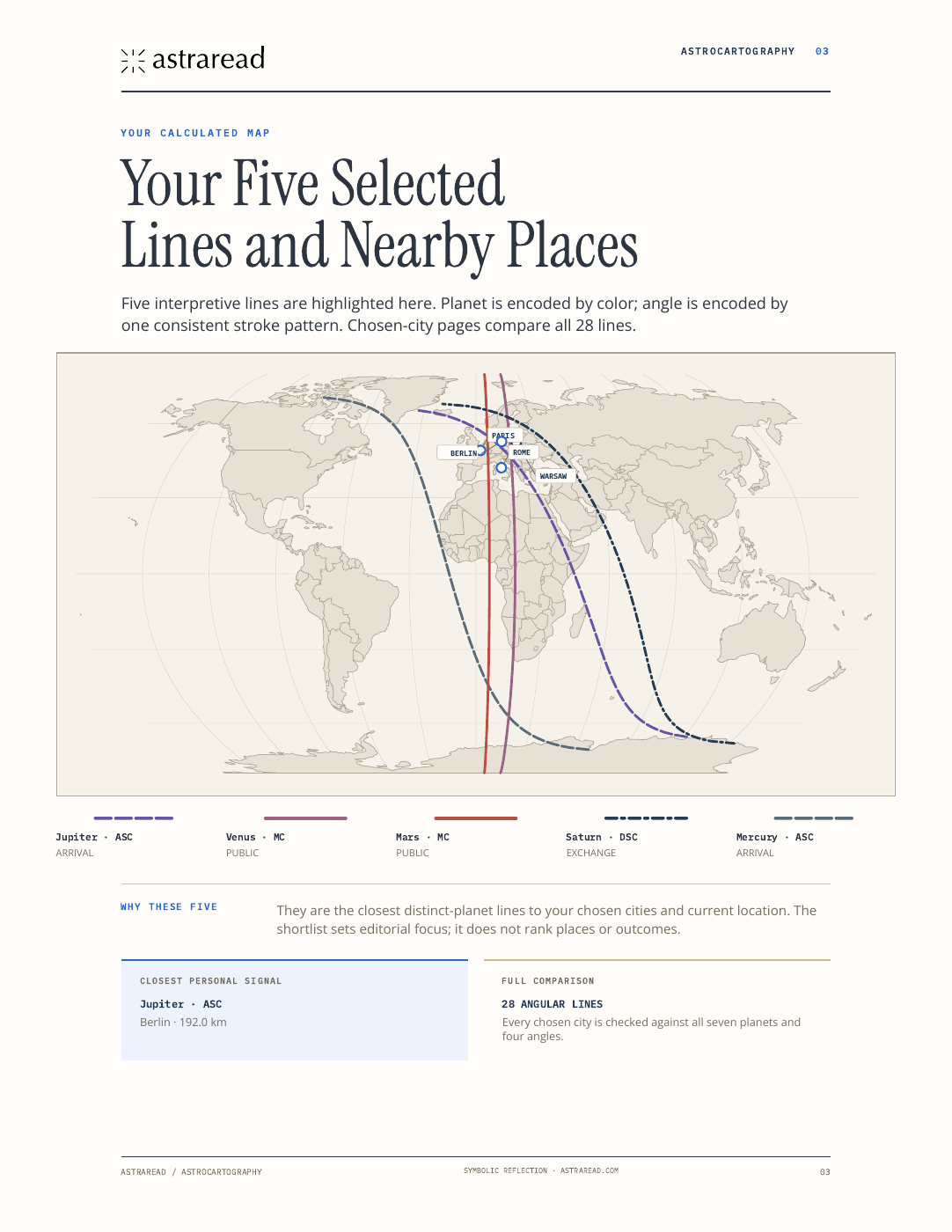
A natal chart fixes a moment in time. Astrocartography calculates where each planet was on one of four angles around Earth at that moment and plots those paths on a world map. The result depends on the recorded local time, birthplace, time-zone conversion and astronomical positions.
The four angular line types
Ascendant lines are associated with self-presentation and beginnings; Descendant lines with encounters and relationships; Midheaven lines with public life and vocation; IC lines with home, roots and private life. These are symbolic conventions, not measured effects on a location.
Why a line is not a promise
A Venus line cannot promise love and a Jupiter line cannot promise wealth. A city also contains labor markets, laws, climate, cost, safety, health access, community and personal history. The map can organize questions, but real-world evidence remains the basis of a decision.
How to compare locations responsibly
Begin with two or three realistic places and note which angular themes are emphasized. Then research the practical constraints separately. Use the map to ask what you hope to express, build or learn in a location—not to rank cities as universally lucky or unlucky.
What a transparent reading should show
A responsible report shows the actual map, names the calculation method, states the birth data used and distinguishes close lines from broad regional interpretation. It should disclose uncertainty, avoid guaranteed outcomes and never replace immigration, legal, financial, health or safety advice.
Common questions
How close do you need to be to an astrocartography line?
Practitioners use different distance ranges, so a report should state its chosen method. Distance is an interpretive convention, not a scientifically validated effect radius.
Is AstraRead astrocartography available now?
Yes. The current 24-page report calculates all 28 angular lines, compares a current location and three selected cities, and shows its selection method and exact distance bands.
Sources and further reading
Continue with this topic
-
Astrocartography vs relocation chart: what is the difference?
Compare an astrocartography world map with a relocated birth chart, including inputs, angles, houses and when each format is most useful.
8 min read · Natal charts
-
How to read an astrocartography map step by step
Read an astrocartography map in a clear order: verify birth data, identify angular lines, measure distance, compare themes and research the real place.
10 min read · Natal charts
-
Can you use astrocartography without an exact birth time?
Understand why guessed or rounded birth times can move astrocartography lines and what safer alternatives exist when the record is unknown.
7 min read · Natal charts
-
What if I do not know my exact birth time?
Find your birth time in a long-form birth certificate, hospital record or family documents. Learn what remains reliable if the exact time cannot be found.
8 min read · How it works
Related personalized reports
-
Astrocartography Reading
Compare three places you are considering with a calculated world map and your current location for context.
24 pages · $19.90 USD · Comparing where you live with three realistic cities
-
Deep Birth Chart Reading
Your whole birth chart, connected: planets, houses, relationships, strengths and recurring patterns.
24 pages · $34.90 USD · A complete, detailed natal reading
Continue exploring
Browse all Journal guides or use the free Destiny Matrix calculator.